POLAND - Russia is preparing to wage war against countries supporting Ukraine by launching missile strikes into their territory, Poland's Prime Minister revealed last night. Donald Tusk issued a chilling warning after the country was forced to close its airspace, scramble fighter jets and close airports due to the Kremlin's latest assault. Addressing Poland's parliament, Mr Tusk said Western intelligence agencies have confirmed Vladimir Putin's preparations for a wider conflict.
UK - A gang of children as young as five have been filmed storming a corner shop in balaclavas to steal while their smiling parents wait outside. Extraordinary footage captured by Dorset shopkeeper Erdogan Yigitoglu, 52, shows the primary school-aged criminals helping themselves to goods worth up to £120. The children have been filmed being 'trained' to steal piles of chocolate bars, disposable barbecues and a range of other items from his shop in Bournemouth. Mr Yigitoglu has spent years sharing CCTV footage of shoplifters online in a bid to deter crime, including young children concealing their identities while stealing. But the most shocking discovery, he says, was seeing the masked youngsters return to waiting adults after their raids. On one occasion, he claimed he watched a mother smile and pat her child on the head in apparent congratulations after a successful haul. 'My biggest wish is that children are taught the difference between right and wrong and are given the guidance they need to grow up as responsible members of the community.'
GERMANY - One third of US troops could be pulled from Europe under plans being considered by the Pentagon. The option to withdraw about 25,000 personnel, mainly affecting Germany as well as Italy and Spain, is among four drawn up during a six-month review announced in June, NBC News reported. Another option goes even further and would involve 40,000 troops leaving, along with planes, ships and weapons that have formed part of NATO’s deterrence against Russia for decades, according to sources who spoke to the network. The withdrawal would follow an initial reduction of 5,000 troops that is under way in Germany and which was announced in May in response to criticism by Friedrich Merz, the German Chancellor, of the US military operation in Iran.
USA - US President Donald Trump said that if Canada became an associate member of the European Union, he would consider it a “hostile act” in comments to the press on Wednesday. "If they do that, if I think it's at all a hostile act, I will put very serious tariffs or stop trading with Europe on many things," Trump said, calling the proposal "laughable." “If it’s a good intention, that’s fine. If it’s a bad intention, we’ll put very heavy tariffs on Europe, which is a possibility,” he said, adding that Canada had been a "terrible trade partner." Canada and the US are currently in a trade war, which is straining relations between the two neighboring countries and leaving Ottawa to seek new trade partners. On Wednesday, European Commission President Ursula von der Leyen announced that she wanted to work with Canada to join the EU as an associate member.
FAR EAST - It was only a matter of time before widespread protests began to occur. Global supplies of gasoline and diesel have been getting tighter for months, and now prices are soaring and rationing has started in some parts of the world. Needless to say, a lot of ordinary people are very angry about this. Large protests have suddenly erupted all over the planet this month, and if the fuel crisis of 2026 continues to intensify it is probably inevitable that the protests will get even larger. Here in the United States, the average price of diesel reached six dollars a gallon for the very first time last week, and a lot of Americans are grumbling about that. But in other parts of the world, people are absolutely livid. In Syria, the government has raised the price of diesel by about 40 percent and the price of gasoline by about 25 percent. This has sparked a series of wild protests all over the country.
USA - The Federal Reserve on Wednesday raised interest rates by 25 basis points – or 0.25%. The Federal Open Market Committee (FOMC) voted 12-0 to increase the benchmark rate to 3.75%. This is the first rate hike since 2023. The rate hike comes just weeks before the midterm elections. President Trump responded to the rate hike: "Interest Rates in the United States should be 1%, or less, because we are the Best Credit in the World — BY FAR. Our Country is BOOMING with new Investment! If we stopped Trading with every country that we have a Deficit with, which is most of them, we would make, at least, 1.5 Trillion Dollars a year. The word 'Deficit' is nothing more than a fancy word for LOSS. We are 'carrying' almost every country in the World, and that cannot go on any longer. LOWER THE INTEREST RATES FOR THE UNITED STATES OF AMERICA, AND FAST! President DONALD J TRUMP"
UK - UK drivers face paying £2.30 per litre for diesel by the end of the year if the Iran war continues to rage, analysts have warned. Global supply constraints from the Middle East conflict mean diesel pump prices could surge by another 19 percent compared with current levels – surpassing the previous record set in 2022 by a margin of 31p per litre, according to Wood Mackenzie. Alan Gelder, from Wood Mackenzie, said that if the war in Iran continues and Ukraine maintains attacks on Russian refineries, factory-gate diesel prices will surge to $285 per barrel, 65 percent above their August average of $173.
UK - Andrew Bailey, the Governor of the Bank of England, says inflation risks are “on the upside” as the Iran war keeps rattling oil prices. And he isn’t alone. Central bankers worldwide fear persistent inflation requires fast action to cool prices, but this theory is wrong-headed. Sustained tightening is both unnecessary and a mistake. Globally, central bankers were scarred by 2022’s hot inflation, a self-inflicted wound created by their massive Covid-era money-supply explosion. They think high oil prices risk driving all prices higher. They think AI data centre build-outs and long-ago-priced US tariffs add inflation tinder. They think wrongly – but most economists were wrongly trained that way. As I wrote here in April, high oil prices alone never fuel true inflation. They drive substitution, mostly dampening luxury-goods demand.
EUROPE - Polish oil refiner Orlen is racing to replace supplies from Saudi Arabia as Houthi attacks on that country's oil infrastructure disrupt deliveries and send the energy markets into further tumult. The Yemen-based Houthis, last week, overran Saudi-backed forces on the Red Sea coastline and launched a string of attacks on Saudi pipelines and critical infrastructure. Those developments have prompted the Saudis to deactivate its main East-West pipeline and seen them struggle to keep up with delivery schedules. Orlen, accordingly, has expanded purchases from myriad North Sea suppliers, Reuters reported, citing "five industry sources."
IRAN - Iran’s top security official warned President Donald Trump on Monday that the strategic balance around the region’s critical waterways has changed, ruling out negotiations until Tehran’s sweeping conditions are met and declaring that American “damage control won’t stop what’s coming.” “Don’t get distracted by the US president’s mixed signals — from ‘no negotiations’ to ‘we’re ready to talk,’” Mohsen Rezaei, secretary of Iran’s powerful Supreme National Security Council, wrote on X. “The stakes around oil and the straits have changed. Damage control won’t stop what’s coming,” he continued. “No talks until Iran’s conditions are met. Period!”
Disclaimer:
The views expressed in this section are not our own, unless specifically stated, but are provided to highlight what may prove to be prophetically relevant material appearing in the media.
“Just what is an APOSTLE?”
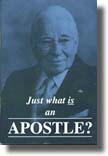
Today we find the Church of God in a “wilderness of religious confusion!”
The confusion is not merely around the Church – within the religions of the world outside – but WITHIN the very heart of The True Church itself!
Read online or contact email to request a copy