IRAN - Iran has drawn up plans to target undersea internet cables in the Gulf if attacked again by the US and Israel, potentially disrupting regional networks. Tehran has drawn up detailed plans to target undersea communications cables in the Gulf if the United States and Israel attack Iran again, two senior Iranian security officials told Reuters. Their comments followed warnings by Iranian officials that undersea cables in the region could become targets in any renewed conflict if diplomacy with Washington collapses. "If Iran is attacked, there will be no more red lines ...from undersea cables to military bases, including covert ones," one of the officials said. The official warned Washington not to "play with fire," and said Iran had full access to the undersea cables and could easily destroy them.
UK - Pig breeders have warned of a potential crisis for British farming after a dramatic plunge in the price of livestock. Farmers said the Government should provide more support after nine native piglets fetched £2 each at auction, less than a supermarket packet of sausages or bacon. Dan Bolton, who sold the seven-week-old Saddleback weaners in Dorset, said he ended up losing money once he had paid the market fees. He said the price was a “record low” and was exacerbated by soaring prices of feed, fuel and electricity. Cheap imports reared to lower standards had also “flooded the market”, lowering prices further, he added.
USA - America provided safe refuge to some who now seek to dismantle it from within. US Representative Ilhan Omar and NYC Mayor Zohran Mamdani are just two examples in a long line of turncoats – those who strive to undermine the very values that protect them. As Americans prepare for the November 3 elections, the federal investigation into congresswoman Ilhan Omar brings to mind a warning from Shlomo Hamelech (King Solomon), “Whoever repays good with evil, evil will never depart from his house” (Proverbs 17:13). America has offered refuge, freedom and opportunity to generations escaping war, persecution and tyranny. Yet today, some of the fiercest debates concern political movements seeking to transform the very institutions that made those opportunities possible. Omar arrived as a refugee from Somalia’s civil war. America offered protection, citizenship, and the opportunity to rise to Congress. Today, she is a leading voice of the Squad, whose progressive agenda challenges American economic institutions and whose positions on Israel have generated repeated controversy.
UK - For a decade or more, “preppers” have been tarnished with the reputation of extreme hoarders or conspiracy theorists, kitting themselves out with crossbows and gasmasks for an apocalyptic disaster. But prepping may be about to go mainstream after the defence secretary told the British public that they too must be prepared for a national crisis. Wes Streeting told people to stockpile three days’ worth of emergency supplies as he launched a “national resilience conversation” on Friday. He urged people to prepare for food shortages and disruption to essential supply chains caused by cyberattacks, state-sponsored terrorism and other threats. The government recommended households keep extra water, food, medical supplies, cash, passport copies and key phone numbers written down.
USA - What Valéry Giscard d’Estaing called America’s “exorbitant privilege” still seemingly reigns supreme. But for how much longer? The one-time French prime minister was referring to the commanding position that the American dollar occupies in global finance as the world’s dominant reserve currency, a role that allows the US federal government to borrow almost without limit at relatively favourable interest rates.
GERMANY - The Eagle’s Nest mountainous retreat built for Nazi dictator Adolf Hitler in the Bavarian Alps has been devastated by a blaze, the German police have said. The former tea house for the leader of the Third Reich, which was constructed on the peak of the Obersalzberg in southern Germany in 1938, sits at an altitude of 1,834 meters (6,000 feet). A fire alarm at the Eagle’s Nest went off on Friday evening, and it was completely engulfed in flames by the time emergency services arrived, the police said. The high elevation complicated the work of some 200 fire fighters, who were only able to extinguish the blaze on Saturday morning, they added. “It is damaged to a large extent. The house is unlikely to be saved,” a police spokesperson told Bild tabloid. The police said that a suspect had been arrested in connection with the fire, but revealed no further details.
GERMANY - The massive data leak comes as Berlin’s political establishment intensifies efforts to legally ban the Alternative for Germany. Germany’s most popular party, Alternative for Germany (AfD), has suffered a massive cyberattack, with unknown hackers reportedly stealing and publishing hundreds of thousands of internal emails, while the country’s political establishment seeks grounds to outlaw the opposition party. The AfD confirmed that a hosting provider working with the party was hacked in September, but disputed suggestions that its current communications systems was compromised. “Only a few email inboxes were unlawfully copied, most of which had not been used for years,” a party spokesman told Bild, adding that current federal party email accounts were unaffected. The AfD condemned the breach as an “attack on the German party system and therefore on democracy” and said it reported the cyberattack to the security authorities.
EUROPE - A trip to Flanders has served as a reminder of the catastrophes the conflict wrought. I’m standing in Tyne Cot Cemetery, in the rolling fields of Flanders. In front of me the graves go on and on, as they are meant to do, because this is the largest Commonwealth war cemetery on Earth. Nearly 12,000 men are buried here, most of them unidentified; 35,000 more are just names on the wall behind me. The sadness is almost unbearable; it is also, for me, unexpected. I visited the Somme 30 years ago, as a younger man, and it was certainly poignant. Yet now I feel bleaker than ever, and I have a hunch why.
FRANCE - Last Wednesday Sébastien Lecornu, France’s prime minister, announced “a significant and large-scale criminal justice response” to the anarchy, hoping to calm the public’s nerves: it does not appear to have worked. A Parisian contact told me on Thursday that the idea of businesses having to hire private security to deter looters seemed to indicate the beginnings of a failed state.
UK - A decades–old piece of software has sparked one of the biggest cybersecurity alerts in recent memory after a hidden security flaw suddenly came to light. Websites around the world have gone dark as hackers launched millions of attempts to exploit a vulnerability in the PHP programming language. This is a critical open–source system that is built into 70 per cent of all websites on the internet, from Wikipedia to government agencies. While these critical weaknesses have been found and patched, cybersecurity experts now warn that over-reliance on ageing software means future crises are inevitable.
USA - One of Anthropic’s cyber security chiefs has warned that IT crises are likely to “get a lot worse” as AI exposes new vulnerabilities for hackers. Jason Clinton, Anthropic’s deputy chief information security officer, issued the stark warning in response to a cyber incident that shut down websites around the world. Posting on social media in response to the PHP security issue, he said: “As bad as things have gotten in the past four days, they are going to get a lot worse before they get better.”
UK - Pope Leo XIV has accepted an honorary title reflecting a “shared desire for Christian unity” between himself and the King, Buckingham Palace has said. The Dean and Canons of Windsor have announced Pope Leo XIV has become Papal Confrater of the College of St George at St George’s Chapel, Windsor. The King and the Queen met the Pope during a state visit to the Vatican in October last year. On that trip, the King was welcomed as Royal Confrater of the Papal Basilica and Abbey of St Paul’s Outside the Walls. On Friday, Buckingham Palace said: “This act of confraternity represents a visible sign of spiritual fellowship, ecumenical friendship and Christian fraternity. It recognises both the centuries-old relationship between the College and Chapel of St George, Windsor and the Holy See, and the progress in relations between the Roman Catholic Church, the Church of England and the Anglican Communion. It also reflects the deep mutual esteem between the Pope and His Majesty and their shared desire for Christian unity.”
[Confrater: "one... devoted to a religious or charitable cause." In this case - “a shared desire for Christian unity.”]
UK - We are sleepwalking into a society where money exists in our bank accounts, but access to it is based on little more than hope. Governments want us to go cashless, but they do not seem to realise that weakening our access to cash is stripping away our freedom. If we cannot access our money when digital systems fail, how much control do we really have over it? The recent Revolut outage is a timely reminder of why cash still matters. Thousands of customers have reported problems accessing funds and making payments, while Lloyds, Halifax and Bank of Scotland have also experienced disruption. With Revolut serving around 80 million customers, the potential scale of disruption is enormous.
IRAN - In Tehran, discussions about Iran’s potential withdrawal from the Treaty on the Non-Proliferation of Nuclear Weapons (NPT) are growing increasingly urgent. Iranian Foreign Ministry Spokesperson Esmail Baghaei has recently acknowledged that the issue is being seriously considered by Iranian officials. His statements lend significant political weight to the discourse around Iran’s potential withdrawal from the NPT: One can no longer downplay it as something proposed by hardliners or fringe groups. While Baghaei also reaffirmed Iran’s commitment to its membership in the NPT and the associated obligations, he made it clear that the possibility of exiting the treaty is being considered.
SAUDI ARABIA - Even an end to the conflict will likely bring little relief, with a fresh demand surge threatening to keep oil markets under strain, Aramco chief Amin Nasser has said. The US-Israeli war on Iran has caused an “unprecedented” shock to global energy markets, removing some 3 billion barrels of oil supply, Saudi Aramco CEO Amin Nasser has warned. The war launched in February effectively shut the Strait of Hormuz, a crucial oil and LNG artery, sending crude prices up roughly 50%. Despite Gulf exports recovering to a reported 80% of pre-war levels, renewed attacks on vessels have kept markets on edge, with Brent hitting a five-month high above $112 this week. Houthi attacks on Saudi energy infrastructure and shipping have compounded the crisis, threatening another vital trade chokepoint, the Red Sea’s Bab el-Mandeb Strait.
Disclaimer:
The views expressed in this section are not our own, unless specifically stated, but are provided to highlight what may prove to be prophetically relevant material appearing in the media.
“Just what is an APOSTLE?”
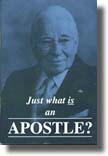
Today we find the Church of God in a “wilderness of religious confusion!”
The confusion is not merely around the Church – within the religions of the world outside – but WITHIN the very heart of The True Church itself!
Read online or contact email to request a copy